
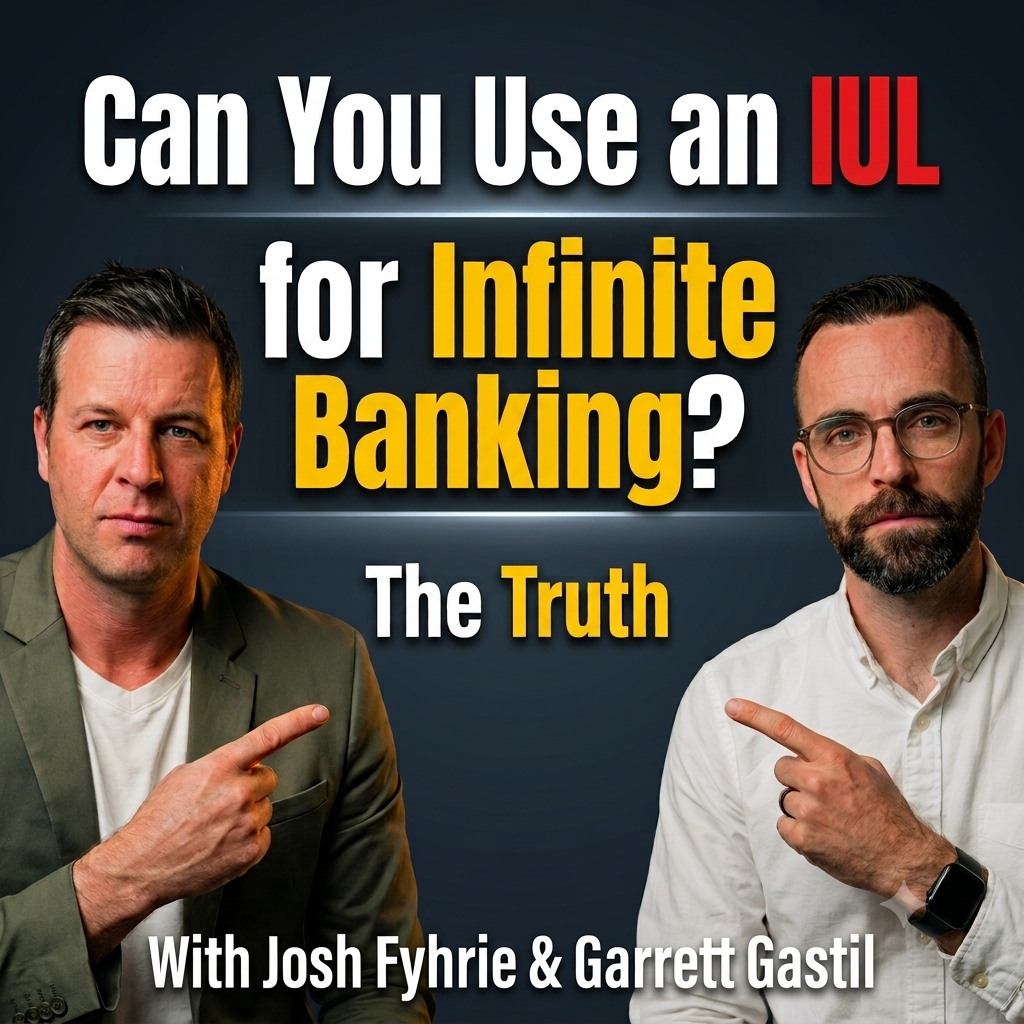



The short answer is no.
The longer answer requires understanding why, because the question is being asked more than ever, and the misinformation circulating on social media around this topic is causing real financial harm to real people.
Right now, social media is full of content promoting Indexed Universal Life insurance as “infinite banking 2.0,” an upgraded, modern version of the concept that Nelson Nash created. It is not. And the man who created IBC said so directly, in writing, on page 39 of Becoming Your Own Banker.
“I never sold one when I was in the business, and I surely wouldn’t buy one. I would not recommend it nor use it for the infinite banking concept.” – Nelson Nash
Nelson Nash spent 35 years in the life insurance industry. He won lifetime achievement awards. He was a member of the Million Dollar Roundtable. He sat on every major committee in the industry. And in all of that time, he never sold a single Indexed Universal Life, variable life or traditional universal life policy.
That statement should do a lot of your thinking for you.
Why Is This Question Being Asked So Often in 2026?
There are three reasons this question keeps coming up.
First, social media marketing. IUL products are heavily marketed online. They illustrate well, meaning the projected numbers look impressive on paper. And they are being marketed aggressively by people who are either uninformed about IBC or who are deliberately misusing the trademark.
Second, the trademark is being violated. The Infinite Banking Concept is a registered trademark of the Nelson Nash Institute. Authorized practitioners — like the advisors at Ascendant Financial have signed an agreement to use the concept and its trademarks correctly. Many people promoting IUL as an IBC vehicle are not authorized and are not following the trademark policy.
Third, people genuinely do not know the difference. And that is not their fault. The distinction between a product and a process is not obvious. If the first content you encounter about IBC is promoting an IUL, it is entirely reasonable to assume that it is the right vehicle.
It is not.
The History of Universal Life: Where It Came From and Why It Matters
To understand why IUL does not work for IBC, you need to understand what universal life actually is and where it came from.
Nelson Nash was direct about this on page 39:
“It was invented in the early 1980s by E.F. Hutton, a stock brokerage firm, in my opinion, that knew nothing about life insurance.”
That matters. How we think about something is shaped by what created it. The insurance industry did not invent universal life to serve policyholders. It was invented by a stock brokerage firm to compete with whole life insurance during a period of high interest rates by unbundling the savings and insurance components of a whole life policy and putting them in a single package under a different structure.
The original format was simple: one-year term insurance with a side fund of an interest-bearing account. In the 1980s, when interest rates were running at 10 to 12 percent, that side fund looked attractive. When interest rates came down, the product evolved, the interest-bearing account became an investment account, then an indexed account tied to market performance.
That is the product being called “infinite banking 2.0” today. A one-year term chassis with an investment element attached to it.
The Hockey Stick Problem: Why ART Costs Destroy IUL Policies Over Time
This is the most important thing to understand about why IUL does not work for IBC.
Most IUL policies are structured with what is called Annual Renewable Term insurance ART, also known as Yearly Renewable Term (YRT). This means the cost of insurance inside the policy is recalculated every single year based on your age.
Here is the logic:
At age 35, the probability that an insurance company will need to pay out your death benefit this year is very low. The cost is low.
At age 55, you are 20 years closer to death. The probability is higher. The cost is higher.
At age 75, the probability is significantly higher. The cost is exponentially higher.
This creates what Richard Canfield calls a hockey stick a cost curve that looks flat and manageable in the early years, then bends upward steeply as you age. And the critical problem is this: the point at which the hockey stick reaches its steepest and most expensive trajectory is exactly the point at which most people want to stop working, stop contributing, and start accessing their policy for income.
You have an inverse relationship. At the moment, the cost is highest, and your ability and willingness to fund the policy is lowest. And something has to give.
How an IUL Implodes: The Mechanics of Compound Decline
When you stop funding an IUL and start drawing from it, two things happen simultaneously that create what Richard Canfield calls compound decline.
First, the cost of insurance must still be paid. It is not optional. If you are not depositing money from outside the policy, the insurance company takes it from the internal cash value. The policy eats itself to pay for its own insurance costs.
Second, if you are also taking policy loans or withdrawals for retirement income, you are reducing the cash value further at the same time.
Compound growth works in your favour when you are depositing. Compound decline works against you when you are withdrawing, and the effect accelerates as the cost of insurance increases with age.
The result, in the most severe cases, is an implosion. The cash value is depleted to the point where the policy cannot sustain itself. The insurance company sends a letter. It might say you owe $72,000 or $125,000 in premiums this year to keep the policy in force at age 83, terminally ill, with no ability to pay.
This is not a hypothetical. This is what is causing the IUL lawsuits that have been all over the news in 2026. Policyholders, many of them elderly and unwell, are receiving letters telling them the insurance they thought they had, funded by decades of premiums, is about to lapse at the moment they need it most.
Why IUL Illustrations Are a Fiction
Garrett Gastil put it clearly in this episode: IUL illustrations assume a consistent market return, often eight percent compounding every year across a multi-decade horizon.
The moment that illustration is printed, it is a fiction.
Not primarily because the market may not perform as projected, though that is also true. The bigger problem is human behaviour. As Nelson Nash wrote, Becoming Your Own Banker is approximately 30 percent about human behaviour. Behaviour matters.
Most people do not fund their policies as projected. Life gets in the way: the kids, the unexpected expenses, a year where cash flow is tight. Miss a year of funding in the early years of an IUL, and the compounding effect that was supposed to carry the policy forward is delayed. Miss a few years, and you are off track in a way that is very difficult to recover from.
In a whole life policy, the contractual guarantees mean the policy continues growing regardless of whether you maximize your optional paid-up addition premium in any given year. In an IUL, the investment return assumed in the illustration and the consistency of your funding are both variables, and both have to go right for decades for the result to look anything like the illustration you were shown.
The Ownership and Control Argument
Garrett Gastil raises one of the most powerful points in the entire episode, one that gets to the heart of why IUL fundamentally cannot be used for IBC.
In a participating whole life policy from a mutual insurance company, you are an owner. Every premium you pay increases your share of the divisible surplus of a company you co-own. You benefit from the company’s performance as an owner. And when you take a policy loan, you are borrowing the insurance company’s money, not your own, while your cash value continues compounding uninterrupted.
In an IUL, you are not an owner. The insurance company is a stock company. The participating policyholders who own the company are the whole life holders; they are the ones to whom the company is responsible. IUL policyholders are customers, not owners. They have no ownership stake. They do not participate in the divisible surplus.
And when you borrow from an IUL because of what is called direct recognition in the US, you often do not even earn the same indexing rate on the borrowed funds. You may have to liquidate your investment units and transfer them to a savings-style account before the company will lend against them. The compounding is interrupted, not preserved.
The entire premise of IBC is becoming your own banker. You cannot be the banker if you do not own the bank.
What to Do If You Already Own an IUL
This is one of the most important practical questions in the episode, and the answer is nuanced.
First: do not panic. Your advisor may have been doing their best with the knowledge they had. Most insurance advisors are caring, well-intentioned people who were not trained on these distinctions. That does not make what you have right for IBC, but it does not make you a victim either.
Second: get a proper review. Book a clarity call with an authorized IBC practitioner. Link in the description below. Come prepared: bring your statement, write down your key questions, and let the advisor understand your situation before the call.
Third: understand the triage approach. Before having an IBC conversation, you may need to have an insurance conversation first. What coverage do you have? Is it good coverage? What were your original objectives? Are there surrender charges? How long have you been funding it? These questions come before the IBC discussion.
Fourth: not all UL contracts need to be cancelled. Some people have universal life contracts, not index that were sold on a level cost basis. These may still serve a legitimate purpose as pure protection coverage. The goal is not to eliminate everything and start from scratch. The goal is clarity, proper coverage, and then a genuine IBC conversation built on the right foundation.
Nelson Nash’s Final Word on the Matter
Page 39 of Becoming Your Own Banker closes with this:
“No, you cannot do infinite banking with a universal life contract of any type. And it is not infinite banking 2.0.”
There is no ambiguity there. The originator of the concept, who held the copyright and trademark, was explicit. If you see content online promoting IUL as a version of infinite banking, you are seeing something that is either uninformed or deliberately misleading.
You have a squishy mass between your ears that can compute that.
Go talk to an authorized practitioner about the concept.
Watch the Full Episode
In the full episode, you will also hear:
- Josh Fyhrie’s full confession about the IUL he bought before he knew better
- The level cost of insurance option a surprising discovery from this recording
- Richard’s explanation of why IUL is 800 pages and whole life is 121, and what that tells you
- The Canadian life insurance industry report shows whole life sales surging and UL declining
- What surrender charges are and how they trap policy owners who want to exit
- The Robert Rickard episode references the most well-publicized IUL lawsuit lawyer in the US right now
Have Questions About Infinite Banking?
Visit ibcfaq.com for straight answers to over 100 of the most common questions about the Infinite Banking Concept, including questions about IUL, policy loans, creditor protection, Canadian vs US differences, and how to get started properly.
Free Resources From Wealth on Main Street
7 Simple Steps: the fastest way to evaluate whether IBC is right for your situation → 7steps.ca
Don’t Spread the Wealth free digital copy with 15-page family banking guide → dontspreadwealth.com
Cash Follows the Leader free copy with 91-year IBC family case study → cashfollows.com
Keep Taxes Away From Your Wealth: Five Strategies to reduce your tax burden → keeptaxesaway.com