





Building a successful real estate portfolio requires more than finding profitable properties.
It also requires maintaining access to capital when circumstances change.
For real estate investors, liquidity is the ability to access money when needed without being forced to sell investments or rely entirely on additional borrowing.
You might own several properties, have significant equity, and generate rental income. But if an unexpected expense arrives and your accessible cash reserves are limited, even a strong-looking portfolio can experience financial pressure.
In Episode 344 of Wealth On Main Street, Richard Canfield speaks with Connor Eagleson about real estate investing, financial preparedness, the risks of leverage, and the importance of maintaining liquidity.
Connor’s perspective is particularly interesting because he has experienced the consequences of borrowing against volatile collateral firsthand.
His story offers three important lessons for investors who want to build wealth while maintaining financial flexibility.
Lesson 1: Owning Assets Is Not the Same as Having Liquidity
Real estate investors often measure financial progress through property acquisitions, equity growth, and rental income.
Those measures matter.
But they don’t necessarily tell you how much capital is available when you need it.
Consider an investor who owns several rental properties. The portfolio may have substantial equity, yet accessing that equity could require refinancing, selling an asset, or applying for additional credit.
Those options take time, involve costs, and may depend on lender approval or market conditions.
Meanwhile, expenses don’t always wait.
A property might need a major repair. A tenant could leave unexpectedly. Financing costs could increase.
A portfolio can be valuable without being financially flexible.
That’s why accessible reserves deserve a place in an investor’s overall strategy.
The Three Buckets of Wealth
During the conversation, Connor explains a framework for organizing capital into three categories.
Bucket 1: Cash and Short-Term Liquidity
This includes accessible reserves intended to help cover unexpected expenses, short-term obligations, and financial opportunities.
Bucket 2: Income-Producing Assets
These include businesses, rental properties, and other investments intended to generate income.
Bucket 3: Long-Term Savings and Investments
This includes capital allocated toward longer-term financial objectives.
The challenge is that ambitious investors may concentrate heavily on acquiring income-producing assets and building long-term wealth while giving insufficient attention to immediate liquidity.
All three buckets serve different purposes.
The goal isn’t necessarily to maximize one bucket. It’s to consider how they work together.

Lesson 2: Leverage Can Create Pressure When Conditions Change
One of the most memorable moments in Episode 344 comes when Connor describes his experience with Bitcoin-backed lending.
Before joining Ascendant Financial as an advisor, Connor worked in the Bitcoin-backed loan industry.
These lending arrangements allowed borrowers to use Bitcoin as collateral.
However, when Bitcoin prices declined, borrowers could face collateral calls requiring them to provide additional security.
Connor experienced this situation personally.
He describes waking up around four in the morning and scrambling to respond to a collateral requirement.
Ultimately, he was liquidated on a Bitcoin-backed loan.
The experience reinforced how quickly financial flexibility can disappear when borrowing arrangements depend on changing collateral values.
What Does This Have to Do With Real Estate Investing?
A Bitcoin-backed loan and a real estate mortgage operate differently.
Connor’s experience was not a property foreclosure, and the lending mechanisms should not be treated as identical.
However, the broader lesson applies to investors using leverage:
Borrowing can amplify financial pressure when asset values, financing conditions, or available cash change.
For real estate investors, that pressure might arise through higher interest expenses, vacancies, maintenance costs, or tighter lending requirements.
Understanding the terms of a borrowing arrangement is just as important as understanding the potential return on an investment.
Before taking on additional debt, investors should consider how their finances would respond if conditions became less favorable.
Lesson 3: A Line of Credit Isn’t the Same as Cash Reserves
Many investors maintain access to a bank line of credit as part of their financial strategy.
That can be useful.
But a credit facility is not identical to money already held in an accessible account.
Depending on the agreement and circumstances, lenders may change credit limits, adjust borrowing terms, or restrict access.
An investor who relies entirely on future borrowing capacity could therefore encounter challenges at the very moment additional capital is needed.
During the episode, Richard and Connor discuss the importance of preparing for unexpected expenses rather than assuming credit will always remain available.
How Much Liquidity Should a Real Estate Investor Maintain?
There is no universal amount appropriate for every investor.
The necessary reserves depend on several factors, including:
- Number and type of rental properties
- Mortgage and operating expenses
- Property age and expected maintenance
- Vacancy exposure
- Personal and business cash-flow obligations
- Other reliable sources of accessible capital
Connor discusses the value of maintaining several months of reserves, but the appropriate amount should reflect an investor’s individual circumstances.
A practical starting point is to review the expenses that must continue even when rental income is interrupted.
Then consider whether those obligations could be met without an urgent asset sale or unexpected borrowing.
Where Does Infinite Banking Fit Into a Liquidity Strategy?
Connor’s financial journey eventually led him to the Infinite Banking Concept and participating whole life insurance.
Through his experience as a policyholder and later as an advisor, he began exploring how properly structured policies could contribute to a broader approach to capital management.
Participating whole life insurance policies may accumulate cash value, subject to policy terms and performance. Eligible policyholders may also have options to borrow against that value.
These arrangements have different characteristics from Bitcoin-collateralize loans, particularly in how collateral and repayment provisions operate.
However, policy loans are still loans. Interest, policy design, borrowing limits, outstanding balances, and potential policy consequences all matter.
Life insurance is not automatically the right liquidity solution for every investor, nor is policy cash value necessarily a substitute for immediately available emergency reserves.
The useful question is how a particular financial tool fits within an investor’s broader circumstances and objectives.
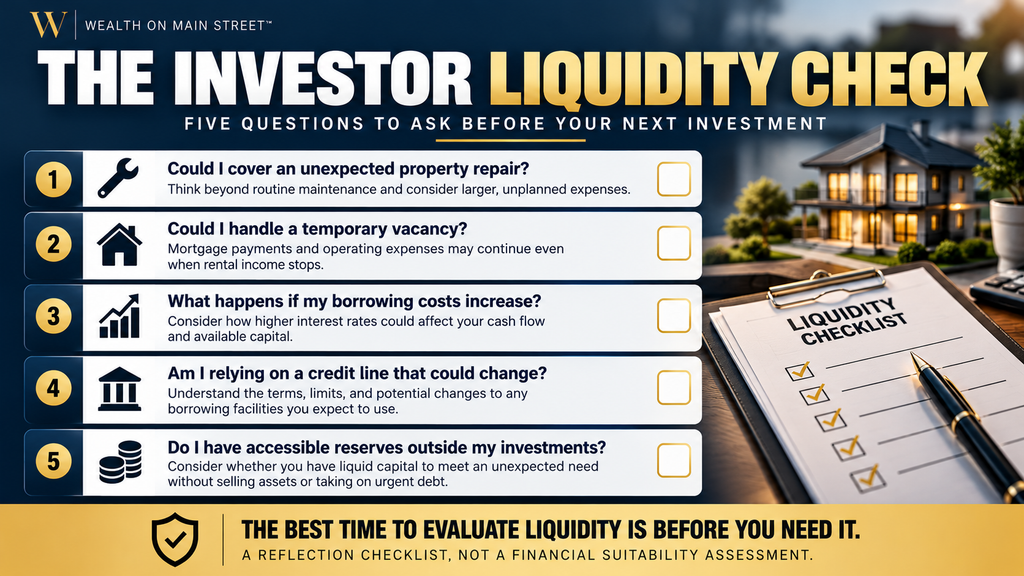
Five Questions to Ask Before Your Next Property Investment
Before committing more capital to an acquisition, consider these questions:
1. Could I cover a major unexpected repair?
Think beyond routine maintenance and consider larger, unplanned expenses.
2. Could I handle a temporary vacancy?
Mortgage payments and property operating expenses may continue even when rental income stops.
3. What happens if my borrowing costs increase?
Consider how higher financing costs could affect your available cash flow.
4. Am I relying on credit that could change?
Understand the terms and limitations of any credit facilities you expect to use.
5. Do I have accessible reserves outside my investments?
Consider whether your available capital could meet an unexpected need without disrupting your long-term plans.
These questions aren’t a substitute for individualized financial planning. They’re a starting point for evaluating preparedness.
The Bigger Lesson: Build Wealth Without Losing Financial Flexibility
Investing is often about putting capital to work.
But successful long-term financial management also requires considering what happens when that capital is needed elsewhere.
Connor’s experience is a reminder that financial pressure can arise even when an investor has valuable assets or promising opportunities.
Maintaining liquidity, understanding borrowing arrangements, and planning for uncertainty can help investors make more informed decisions.
The objective isn’t to avoid every financial risk.
It’s to understand the risks you’re taking and prepare for the situations that could challenge your strategy.
Watch Wealth On Main Street Episode 344
In this conversation, Richard Canfield and Connor Eagleson explore the importance of liquidity, the three buckets of wealth, lessons from Bitcoin-backed lending, and the role participating whole life insurance may play in a long-term financial strategy.
Watch the full episode: Why Real Estate Investors Need Cash Before the Market Turns
This article is intended for educational purposes and does not constitute personalized financial, investment, tax, or insurance advice.