
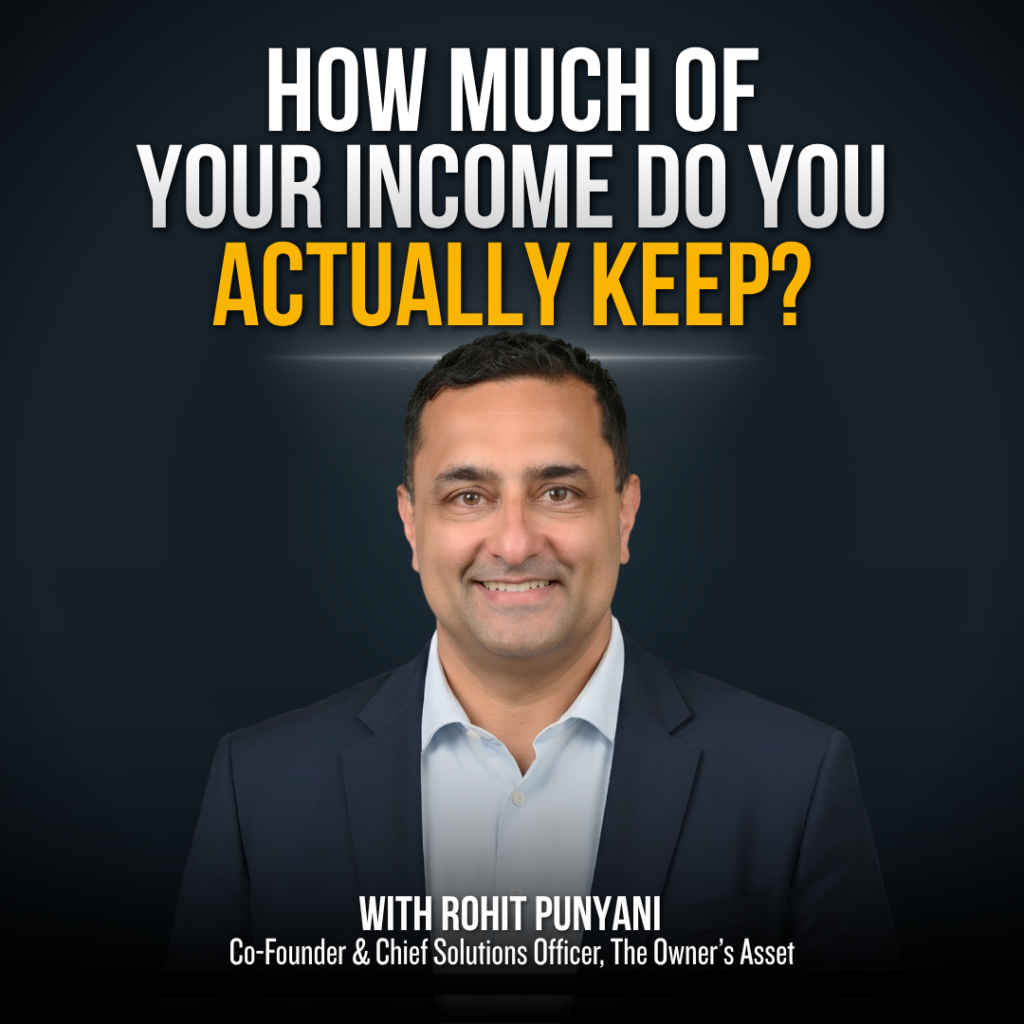



Most financial conversations with business owners start the same way: “How much did you make?”
Rohit Punyani, Co-Founder & Chief Solutions Officer of The Owner’s Asset, a pension specialist and former Chief Investment Officer, joins Jayson Lowe and Richard Canfield to go a lot deeper than that. Here’s what the conversation actually covers.
Why does “cash flow” matter more than “income”?
“The words we use determine our wealth,” according to Rohit Punyani. “If you say I want more income, you’re gonna end up okay. But if you say I want more cash flow, the world is yours and everything in it.” Income is what comes in; cash flow is what you actually control and can direct.
Why should taxes be treated as their own asset class?
Rohit’s re-frame: “Taxes are an asset class onto themselves. If we’re willing to plan for how much equities we have, or plan for retirement, taxes should be part of planning.” Most people plan their equity allocation and retirement contributions but never plan their tax exposure the same way.
Can a tax-efficient strategy still be a bad decision?
Yes. As Jayson Lowe puts it: “A strategy can be mathematically tax-efficient, but practically terrible for the person using it.” The math working on paper doesn’t guarantee the strategy fits the person’s actual life, liquidity needs, or goals.
What do successful business owners have in common?
Rohit says he can often tell before he ever sees a bank statement. It comes down to one word: control, actively directing cash flow rather than passively watching it move through the business.
What is a cash balance plan, and how long does it take to fund one?
A common misconception: people watch a few videos online and assume they can simply “dump” a chunk of money in. In reality, a cash balance plan is a real commitment with contribution minimums and multi-year requirements, a 3-year horizon is possible, but 5+ years is the realistic target.
Who is this NOT a good fit for?
It doesn’t work well for someone who can’t commit for at least 3 years. Rohit shares a real example: a real estate agent who wanted in but was living off a HELOC with inconsistent year-to-year income, not a fit for this kind of plan.
Good deductions vs. bad deductions: what’s the difference?
Writing off a large vehicle Rohit’s example is a $90,000+ SUV, can feel like a smart tax move, but it often means buying a depreciating liability, not an asset. A cash balance plan is framed as a “good deduction” because the money builds something that’s actually yours.
Can you just move a large sum of money in at once to get started?
No. People hear these strategies described online as “the greatest thing since sliced bread” and assume they can dump money in immediately. In reality, there’s a minimum premium commitment and a required funding period, a structured, multi-year approach, not a single transaction.
Frequently Asked Questions
Why does cash flow matter more than income? Income is what comes in; cash flow is what you actually control and direct. The distinction shapes financial decision-making more than the raw income number does.
What is a cash balance plan? A retirement structure with contribution minimums and multi-year funding requirements, not a one-time deposit. A realistic funding horizon is 3–5+ years.
Should taxes be planned like an asset class? Yes, according to this episode, the same way you’d plan equity allocation or retirement contributions, tax exposure deserves proactive planning rather than once-a-year handling.
What’s the difference between a good and bad tax deduction? A bad deduction (like writing off a large vehicle) often means buying a depreciating liability. A good deduction builds an asset you actually keep.
Resource mentioned in this episode: Cash Follows the Leader
Watch the full conversation: https://youtu.be/rkzHvdC_uec?si=XjsQAL0VmiS8i_lN
The Owner’s Assets built a playbook specific for CPAs and advisors who want to get savvy on the massive tax implications. Access it here: https://bit.ly/4xUDXxB