



- Q1: What Interest Rate Is Charged on Policy Loans?
- Q2: What Happens If You Don't Repay a Policy Loan?
- Q3: What Is the Difference Between Whole Life and Universal Life?
- Q4: Is the Death Benefit Tax-Free?
- Q5: Are Dividends Taxable? Is a Dividend Considered Income?
- Q6: Why Isn't Everyone Doing This?
- The Core Idea
If you’ve ever gone down the rabbit hole of the Infinite Banking Concept (IBC) online, you know the experience well: half the comments say it’s the most brilliant financial strategy they’ve ever encountered, and the other half insist it’s an elaborate scam usually from someone named “Crypto Wolf 1978” with a cartoon profile picture who has suddenly become a leading actuarial expert.
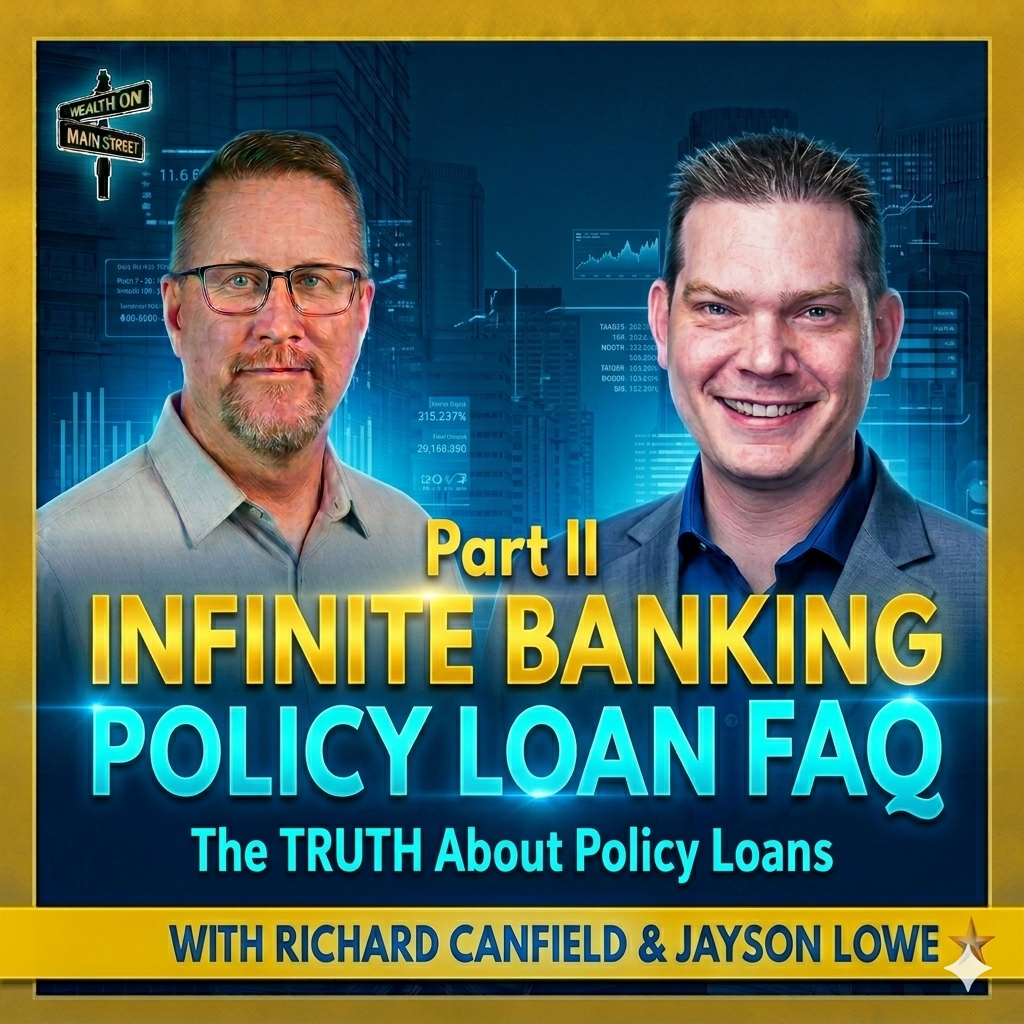
In this episode, Jayson and Richard tackle the questions they hear most often plainly, honestly, and without the noise. Here’s a breakdown of everything covered in Part 2 of their Infinite Banking FAQ series.
Q1: What Interest Rate Is Charged on Policy Loans?
This is one of the first questions people ask, and while it’s a valid one, it’s also one of the last things you should be evaluating when choosing a carrier.
Policy loan interest rates vary by carrier and typically range from 5% to 9%, depending on the company and the current rate environment. Some carriers tie their loan rate to the prime rate; others base it on long-term internal assumptions about their participating account performance. At the time of recording (May 2026), rates in the range of 5.5%–7% are common depending on the policy vintage.
But here’s the more important framing: one Nelson Nash made brilliantly in Becoming Your Own Banker: IBC is not a function of interest rates. The real question is not “what rate am I paying?” it’s “where is the money flowing, and who is it working for?”
When you borrow from a conventional bank, your principal and your interest permanently leave your ecosystem. The bank’s shareholders benefit. When you borrow from your life insurance company, one you co-own as a participating policyholder and you repay that loan on your own schedule, both the principal and interest flow back to an entity that works for you. That’s a fundamentally different relationship with money.
Rate shopping before understanding that distinction is like staring at the cost of fertilizer while ignoring the growth of the entire orchard.
What should you be evaluating in a carrier? Dividend history, participating account management, loan process transparency, and ease of doing business. Loan rate is somewhere near the bottom of that list.
Q2: What Happens If You Don’t Repay a Policy Loan?
Policy loans are unlike any other type of borrowing. There’s no credit check, no income verification, and no one calling you demanding monthly payments. The capital is available on demand, on your terms, and repayment is entirely unstructured.
That flexibility is one of IBC’s most powerful features. It’s also one of its greatest responsibilities.
If you don’t repay a policy loan, the outstanding balance continues to accrue simple interest. If the loan balance grows too large relative to the policy’s cash value, the policy can eventually lapse, and if it lapses with gains inside it, there can be tax consequences.
The key principle here: flexibility is not the same as irresponsibility. If you’re already financially disciplined, if you have a track record of repaying conventional lenders on time, you’ll likely do just fine with the responsibility that comes with policy loans. If you wouldn’t, that’s worth examining honestly before implementing this strategy.
As we often say: wisdom matters more than enthusiasm. Never take a policy loan without a repayment plan already in place.
Q3: What Is the Difference Between Whole Life and Universal Life?
This question matters enormously, because they are not interchangeable, especially for IBC purposes.
Dividend-paying participating whole life is a unilateral contract. 100% of the risk sits with the insurance carrier, not with you. You receive contractually guaranteed daily growth, contractually guaranteed access to capital, a guaranteed (and typically increasing) death benefit, tax-sheltered accumulation, and dividends as a co-owner of a mutual insurance company. The insurance company manages the investment function, and they’re far better at it than most of us would be. It’s as close to “set it and forget it” as financial tools get.
Universal life, by contrast, is what one of us described as “term insurance with a slot machine attached.” It’s flexible, has more moving parts, depends on market performance and investment selections, and requires ongoing active management. Costs can increase significantly as you age, particularly with a yearly renewable term (YRT) structure, where the cost of insurance spikes exponentially as you approach natural mortality. If you stop paying premiums at precisely the moment when the cost of insurance is climbing most steeply, the policy can implode, pulling from internal cash value to survive, or lapse altogether.
We’ve had a lawyer on our platform whose primary job is managing class-action lawsuits against companies and advisors who sold universal life policies that were never designed to perform as promised. We meet clients regularly who have these structures; they looked great on paper at the time of sale, but the market changed, the behaviour wasn’t maintained, and the coverage they needed most is now at risk.
Their position: They have never illustrated, sold, or purchased a universal life policy for IBC implementation. If you’re evaluating this concept, make sure you’re working with participating dividend-paying whole life.
Q4: Is the Death Benefit Tax-Free?
Generally, yes, and it’s one of the most meaningful wealth transfer advantages available.
Death benefits paid to named beneficiaries from a properly structured participating whole life policy are received income tax-free in both Canada and the United States. The capital transfers immediately and privately, outside of probate, to your beneficiaries.
This is a significant reason why dividend-paying whole life plays such a central role in estate planning, business succession, and family legacy planning. Jayson and Richard have delivered a substantial number of death benefit claims over the years. Not once has a family said, “I wish this cheque were taxable and I hoped it would be less money.”
A couple of nuances: the policy must be in force at the time of death, and ownership and beneficiary structure matters particularly in Canada when dealing with corporately owned life insurance and capital dividend accounts.
The broader observation: the two certainties in life are death and taxes. The properly structured whole life insurance contract is one of the few tools designed to address both simultaneously.
Q5: Are Dividends Taxable? Is a Dividend Considered Income?
This is where people often confuse insurance dividends with stock dividends. They use the same word. They are not the same thing.
Insurance dividends, declared and paid by a participating mutual life insurance company, are treated as a return of premium. When those dividends are directed into paid-up additions (PUAs), they are used to purchase more insurance coverage. They stay within the ecosystem of the insurance contract, and they are not taxable. In fact, because PUAs purchase more death benefit than the dividend itself is worth, they create an increasing tax-free outcome. You’re not paying tax; you’re compounding tax-free.
The taxable scenario only arises if you elect to receive dividends in cash or use them to reduce premiums to the point where they begin flowing out to you personally. The election you make when structuring your policy determines the outcome. For IBC purposes, the paid-up additions election is widely recognized as the most efficient.
Q6: Why Isn’t Everyone Doing This?
Honestly? A combination of four things: knowledge, aptitude, decision fatigue, and about 60 years of the conventional financial machine doing what it was built to do.
For decades, the financial industry’s entire marketing infrastructure has been built around one message: give your money to someone else to invest. RRSPs, 401(k)s, mutual funds the boiled frog has been sitting in lukewarm water for so long that most people don’t even notice the temperature rising. They’ve been trained to outsource financial thinking.
Add to that the visceral reaction many people have to the word insurance. A bad experience with travel insurance, a friend’s car accident claim that didn’t pay out, a general distrust of insurance salespeople these emotional associations create a kind of mental freeze that shuts down rational thought before a conversation can even begin. As Nelson Nash called it: the arrival syndrome. The feeling that you’ve already learned enough, that there’s nothing new to consider. That feeling, when it’s attached to an emotional charge, actively prevents people from absorbing information that could change their financial lives.
The reaction we hear most often, once someone genuinely understands the mechanics, is: “Why did nobody explain this to me sooner?”
The answer is simple: explaining money properly is much harder than selling debt. And debt sells itself.
The Core Idea
Financial frustration, for the overwhelming majority of people the Ascendant Financial team speaks with, comes from one root cause: giving away control of their money their entire lives without stopping to question it. They finance everything through conventional lenders. They transfer interest away permanently. They park money in places they can’t access efficiently. And then they wonder why they feel financially squeezed despite earning a solid income.
IBC is not a get-rich-quick scheme. It’s not a secret loophole discovered by a guy on YouTube wearing sunglasses indoors. It’s a disciplined financial behaviour paired with a reliable, time-tested financial tool. That’s it.
Once you understand the mechanics, the decision becomes obvious. The question is just whether you’re ready to have the conversation.
Ready to find out if this is the right fit for your family?
Download our free 7 Steps Guide at 7steps.ca, a smart, time-saving roadmap that helps you evaluate the process quickly so you can move forward with total confidence.
Or visit dontspreadwealth.com for a free digital copy of Don’t Spread the Wealth, a proven process to keep your money in your family forever, finance life on your terms, and pass on real control.
Until next time, keep asking great clarifying questions.