


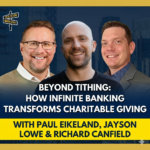

Discover how Paul Eikeland, a former pastor, applies the Infinite Banking Concept (IBC) to optimize charitable giving and leave a lasting legacy for families and nonprofits.
In a world where financial strategies often focus solely on personal gain, the idea of integrating personal finance with altruistic giving can seem revolutionary. But what if there was a way to amplify your charitable impact, ensure a lasting legacy, and still maintain control over your money? This is precisely the intersection where Paul Eikeland, a former pastor turned financial guide, has found his stride, leveraging the principles of Infinite Banking (IBC) to redefine philanthropy.
Eikeland, deeply respected for his mission-driven approach, doesn’t view IBC merely as a financial process. For him, it’s a powerful tool through the lens of stewardship, enabling individuals and organizations to shepherd their resources more effectively, both spiritually and financially.
The Unexpected Path: From Pulpit to Policy
Paul’s journey to the world of Infinite Banking was anything but conventional. Before dedicating his life to financial stewardship, he spent 11 years as a pastor, guiding families spiritually. Yet, the seeds of IBC were planted much earlier.
“I’m pretty fortunate. Let’s go back a little bit further. Okay. Uh so a friend slashmentor uh you know gave me a book way back before that and said Paul give me 30 bucks and read this book right and you know that incredible person his name starts with an R and ends with a D and uh and so I got introduced to the concept even before you know the pastoring and and that kind of season of my life happened.”
Interestingly, Paul had even considered getting licensed to help people with IBC before his calling to the ministry. After over a decade of shepherding young people and leading church communities, he found his way back to the principles that had quietly resonated with him for so long. This full-circle journey highlights a powerful truth: the mission didn’t change, only its outward expression.
The Financial Realities of Nonprofits
Working intimately within the nonprofit sector, particularly with youth, Paul gained firsthand insight into the constant financial balancing act faced by these organizations. While driven by passion and volunteer effort, nonprofits, just like businesses, require a steady flow of capital to operate.
“Money’s got to flow in and then money’s got to flow out… whether it’s church or uh you know mosques or anything like that or nonprofits that are helping care for um you know different like sports organizations all these different organizations like we never really see the behind the scenes.”
From covering essential costs like utilities and supplies to funding critical programs like youth camps, money is indispensable. Paul experienced the challenge of needing to cast vision to attract donations or, at times, making do with zero budgets. His experience underscores a critical point: while the ultimate goal of a nonprofit isn’t profit, efficient financial flow is paramount to achieving its mission.
Rethinking Your Donations with Infinite Banking
Paul’s personal revelation came early on when he realized he could optimize his own charitable giving through IBC. Instead of simply donating money that would be spent and gone, he began to leverage his infinite banking policies.
“What I was able to do was, you know, I took the money I was going to give, put it into my my family system, my, you know, in uh, you know, build build the infinite banking concept in my life and and practice that process and and as I was doing that it was, you know, still had access to that capital that I could now give to the church…”
The mechanism is simple yet profound. Instead of directly donating your monthly or annual contribution, you can funnel that money into your high cash value life insurance policy. When a need arises for a donation, you can take a policy loan and contribute that capital. This allows your original funds to continue compounding within your policy, generating growth that will ultimately contribute a much larger sum (e.g., via the death benefit) to your chosen causes in the long term, while still providing immediate support.
Key Benefits of this Approach:
- Long-Term Impact: Your legacy donation grows significantly over time, far exceeding what simple annual gifts might achieve.
- Immediate Access: You can still provide lump-sum donations to organizations when critical needs arise, without depleting your primary savings.
- Financial Flexibility: Your capital remains accessible for other personal or business opportunities, aligning with your financial goals.
- Enhanced Generosity: Knowing your future impact is secured can inspire even greater current giving.
This method allows you to be both a consistent giver and a strategic steward, ultimately multiplying your impact for the organizations you care about most.
Legacy Beyond Material Wealth: Intergenerational Values
Beyond immediate donations, Paul emphasizes the long-range thinking at the heart of IBC, particularly when it comes to legacy. He challenges individuals to look 100 years into the future and consider the true legacy they wish to leave behind.
“What’s the legacy you want to leave behind?”
This isn’t just about financial inheritance; it’s about transferring values, ambitions, perseverance, and a wealth mentality across generations. Financial discussions often default to material bequests (watch collections, property, etc.), but Eikeland, and the Ascendant team, advocate for cultivating intergenerational values that ensure financial integrity and family flourishing for decades.
Starting the Legacy Conversation:
- Focus on Values: Instead of money, discuss core values like respect, responsibility, and kindness that can be passed down.
- Lead by Example: Your current actions and financial decisions are the most powerful blueprint for future generations.
- Think Long-Range: Consider the impact of your choices not just next month, but 10, 20, or even 50 years from now.
Initiating the Conversation with Nonprofits
For those inspired to share this concept with their favorite nonprofits or churches, Paul offers pragmatic advice: start with relationship.
Trying to impose a new financial model on an organization without an existing foundation of trust is likely to meet resistance. Instead, build genuine relationships with leaders, demonstrate the principles of IBC in your own life, and then share your personal success story.
- Build Trust: Cultivate a relationship with leadership within the organization.
- Share Your Story: Explain how IBC has impacted your own giving and financial life.
- Focus on Education: Encourage leaders to explore the concepts themselves, perhaps by reading fundamental texts like Nelson Nash’s “Becoming Your Own Banker.”
- Collaborate: Instead of a single voice, mobilize a few like-minded individuals within the organization to present the idea, fostering broader buy-in.
Ultimately, the goal isn’t to “sell” a product, but to facilitate a conversation that opens eyes to new possibilities for sustainable growth and amplified impact.
Conclusion: A Mission That Looks Different
Paul Eikeland’s journey is a testament to the adaptability and profound potential of the Infinite Banking Concept. It demonstrates that financial tools, when viewed through a lens of stewardship and long-term vision, can serve a higher purpose: enabling individuals and organizations to fulfill their missions and leave a truly meaningful legacy. The mission to help didn’t change; it just looks different – more strategic, more impactful, and more enduring.
Watch the Full Conversation!
Inspired by Paul’s insights? Dive deeper into this transformative discussion and learn more about how the Infinite Banking Concept can revolutionize your approach to charitable giving and personal finance.
Watch the full episode with Paul Eikeland on Wealth on Main Street now! Don’t forget to subscribe to the channel and hit the notification bell for more invaluable content.