
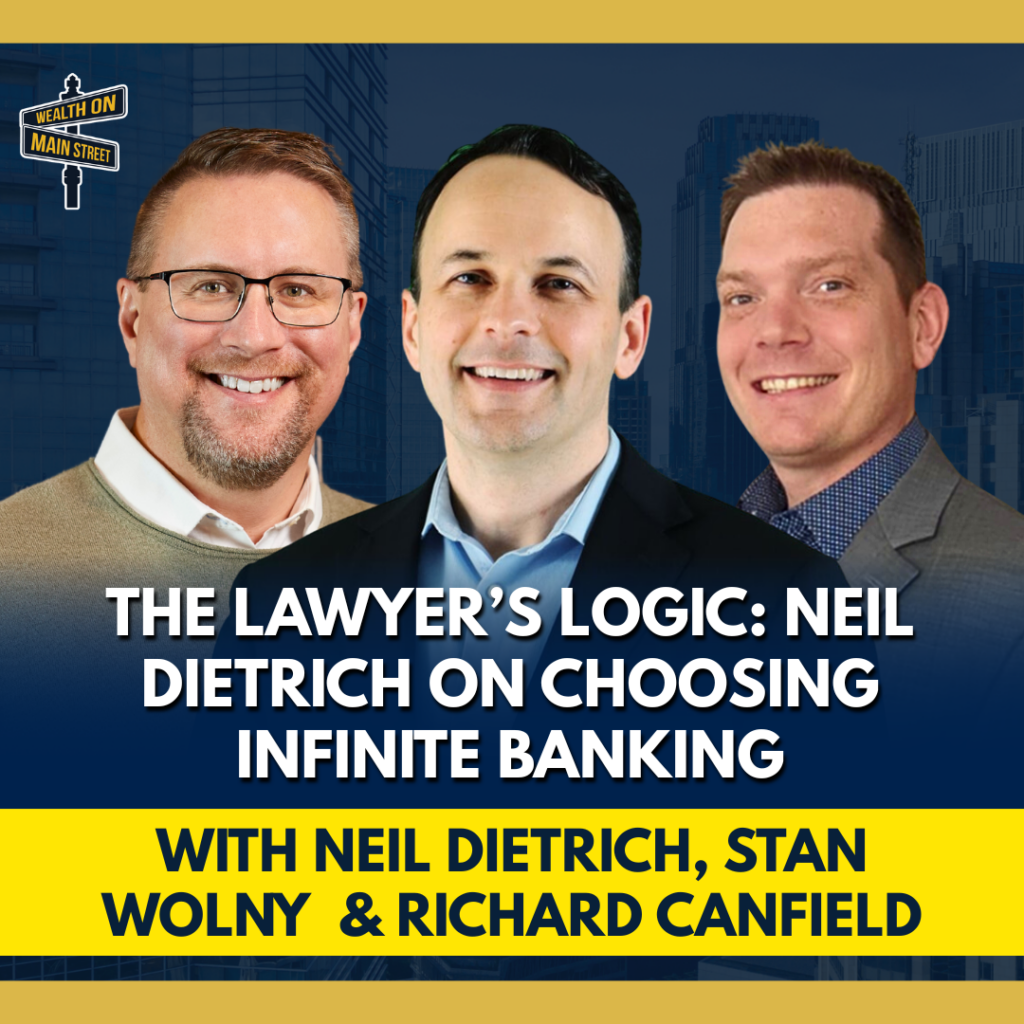




Neil Dietrich on Golden Handcuffs, Reinvention, and the Most Compelling Money Argument He’s Ever Seen. Some career paths come with a script you’re “supposed” to follow. You work hard. You climb. You earn the credentials. You build a reputation. You collect stability… and eventually you realize the stability has become a cage.
Neil Dietrich knows that feeling, because he lived it.
In this episode of Wealth on Main Street, Jayson Lowe and Richard Canfield sit down with Neil, a former Crown attorney (government counsel) who spent 16 years in public service, including 13 years in criminal prosecution. On paper, walking away doesn’t make sense. But life isn’t lived on paper.
Neil stepped out of certainty, out of the “golden handcuffs,” and into a new arena: coaching families to build control, clarity, and long-range financial strength through the Infinite Banking Concept (IBC).
This episode is about reinvention, yes, but it’s also about something deeper: What happens when someone trained to spot risk learns how to spot opportunity, too?
The moment the golden handcuffs became visible
Neil describes a reality that many public-sector professionals will recognize: the longer you stay, the harder it becomes to leave. Not because you can’t leave… but because walking away starts to feel irrational. There’s the pension horizon. The salary. The benefits. The identity. The “safe path.”
Yet, Neil noticed something shifting, especially post-pandemic, where the institution's values no longer aligned as cleanly with his own. He wasn’t “five years from retirement.” He still had runway. That runway mattered.
Because when you still have time, you still have options.
Skepticism, research… and a very “lawyer” move
Before Neil joined Ascendant Financial, he was a listener, absorbing podcasts, learning the concepts, and feeling that internal tension every logical professional feels when something challenges the status quo.
He didn’t rush into it. He did what a seasoned legal mind does: he tried to disprove it. Neil actually reached out to past podcast guests and connected with them directly, people who had no vested interest in selling him anything, just to validate whether what he was hearing was real.
That alone is worth reflecting on. Because skepticism isn’t the enemy. Unexamined assumptions are. Neil kept turning over stones. He kept testing the argument. And eventually… he got in the pool. He became a client first. He built his own family banking system. Then, something happened: the concept stopped being “interesting” and became compelling.
“Infinite Banking is the most compelling argument I’ve ever come across.”
That’s a big statement, especially coming from someone whose entire career was built around building cases and testing arguments. Neil explains it clearly: This isn’t about selling. It’s about teaching. Nobody “sold” him IBC.
He was educated into clarity, and then he made a decision with confidence. That’s the posture Ascendant is known for: helping people understand the problem, understand the process, and decide what fits. Because real confidence never comes from pressure. It comes from comprehension.
Why “expert lanes” matter more than people realize
Neil shared a powerful insight from the courtroom: In law, experts must meet a standard to give testimony, and they cannot operate outside their lane.
Neil applies that same logic to money. Many people, when hearing about IBC, run to a friend, an accountant, or a traditional advisor. That’s not wrong… but Neil raises a critical question:
Are they qualified to evaluate this process? Or are they reacting outside their expertise? He models what integrity looks like, too: he’s not a tax expert, so he encourages clients to confirm tax details with their accountant. That’s what professionals do: stay in lane, and guide people to the right experts when needed.
The real problem: one bad week away from a GoFundMe
One of the most sobering moments in the episode is when Neil describes what he sees in many families: they’re working. They’re saving. They’re trying, but they’re not getting ahead. Many are one bad day, a death, an illness, a job loss away from needing a GoFundMe.
Richard adds an important perspective here: the life insurance industry originally functioned as a community-based solutionessentially the original “GoFundMe” but structured, contractual, and designed to create certainty.
Neil ties it back to purpose: when people are emotionally wrecked, the last thing we want is for them to be financially wrecked too. That’s where planning for the knowns matters:
- People will die.
- Emergencies will happen.
- Repairs will come.
- Transitions will show up.
IBC doesn’t eliminate pain. But it can remove financial chaos in the hardest moments.
Why Ascendant’s client support model is a differentiator
Neil also pulls back the curtain on something many listeners don’t fully see: Ascendant isn’t a one-person shop. Clients aren’t relying on one advisor wearing 17 hats. Instead, they move through an ecosystem that includes:
- A client portal built for ongoing learning
- A deep library of videos and education
- Specialized team members supporting applications and policy servicing
- Quarterly coaching and community touchpoints
- A large team across Canada and the U.S. that advisors can lean on
Neil’s point is simple: at every stage, clients can interact with someone whose lane is that stage without burnout and without gaps. That structure allows advisors to focus on what matters most: coaching, clarity, strategy, and implementation.
What surprised Neil most after joining the team
Neil admits something refreshingly honest: as a client early on, he wasn’t fully implementing the process. He “owned a policy,” used it occasionally, but didn’t yet have the full strategy lens. Once he stepped into the advisor training environment, he saw:
- How many strategic angles exist inside the process
- How important coaching is (not product knowledge)
- How easy it is for people to miss the bigger picture without guidance
That’s a key takeaway for listeners: Having a policy is not the same as running a system. Infinite Banking is a process, and processes require coaching to execute well.
The hero question… and Neil’s answer
Every episode ends with one question: Who do you most want to be a hero to? Neil answers in two layers. Yes, his clients. But personally? His great-grandchildren.
Because if he’s done this right, he won’t just pass down money. He’ll pass down knowledge. And knowledge is what creates multi-generational continuity.
Final thoughts
Neil’s story is a reminder that:
- You’re allowed to outgrow your old path.
- “Stability” isn’t always freedom.
- Skepticism can be healthy when it leads to learning.
- The right environment accelerates growth.
- And the most powerful legacy isn’t a number, it’s the thinking that built it.
If this episode stirred something in you, if you’ve been asking yourself, “Is there more for me than the path I’m already on? ”don’t ignore that. Curiosity is often the beginning of reinvention.
Listen to the full episode
Search Wealth on Main Street wherever you get your podcasts, or watch on YouTube.
Want help thinking through your own next step?
Start by learning the fundamentals of Infinite Banking and what “building a family banking system” actually means, then decide from a place of clarity. Because your money has to reside somewhere. Make sure it resides with purpose.